
Built to pass the review, not just the demo.
Chronum's architecture is built around the questions a security team actually asks: tenant isolation, identity, encryption, evidence, and where your data physically lives.
Six things a security review asks about
Each is a property of the architecture rather than a setting someone has to remember to switch on.
Tenant isolation
Every tenant is isolated at four independent layers: database row-level security, ORM-level tenant scoping, token scope validation, and resolver-level authorization with object-level ownership checks before any read or write.
Identity & access
SSO/SAML, enforced multi-factor authentication, session controls, IP allowlisting, and role-based access control with custom roles — administered from a single console with full audit visibility.
Encryption
Data is encrypted in transit and at rest. Desktop capture is queued locally in an encrypted store before sync, so activity data never sits unprotected on an endpoint.
Audit spine
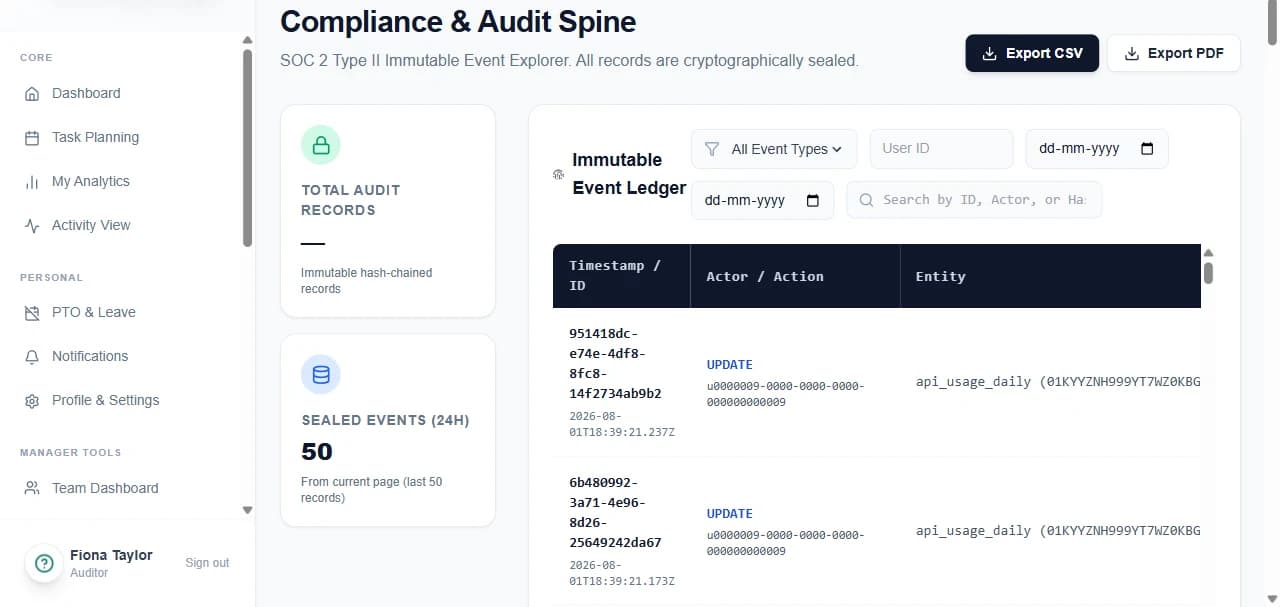
Every approval, correction, policy change, export, and access denial is recorded continuously to a tamper-evident audit trail — evidence is a property of how the system operates, not a project you run before an audit.
Data governance
GDPR access, export, and erasure workflows; configurable data residency; consent records; legal hold; and retention policy defined per data category, not applied as a single blunt setting.
Deployment flexibility
SaaS, single-tenant SaaS, hybrid with a customer-managed data plane, or fully on-premise and air-gapped — the same platform, so a deployment requirement doesn't force a different product.
Evidence as a by-product
Most organisations assemble compliance evidence after the fact, from systems that were never designed to produce it. Chronum records every user action, system action and configuration change into an append-only spine as it happens — so the evidence already exists when someone asks.
- Append-only
- UPDATE and DELETE are blocked at the database constraint level — inserts only.
- Hash-chained
- Each record carries the SHA-256 hash of the previous one, so tampering breaks the chain.
- Externally checkpointed
- Merkle root checkpoints are written to immutable object storage for third-party verification.
- Fully attributed
- Actor, tenant, action, entity, before/after state hashes and UTC timestamp on every record.
- Queryable
- Filter by actor, action type, entity, entity ID and date range; paginated CSV/JSON export.
- Role-restricted
- Spine access is limited to the Auditor and Admin roles; the Auditor role holds zero write privileges.
Four roles, four different views of the same record
Scope is enforced server-side on every request, not just reflected in what the interface chooses to show.
| Role | Can see | Can change |
|---|---|---|
| Employee | Their own plan, timeline and corrections — plus everything recorded about them | Own plan and correction requests |
| Manager | Their team's plans, approvals and analytics | Approvals, team plan and capacity decisions |
| Auditor | Org-wide, read-only | Nothing — zero write privileges by design |
| Admin | Tenant-wide configuration and system health | Roles, policy, integrations and tenancy |
The half most tracking tools skip
A monitoring product that employees cannot inspect is a product they will resist, and a record nobody can challenge is a weak one. Chronum gives every person a Transparency Panel over their own data, and a correction path that reaches a human rather than a void.
- See every activity entry, screenshot and log that exists about you
- Export up to 90 days of your own data as JSON or CSV
- Challenge any entry through the correction workflow
- Request human review of any AI decision that affected you
- Personal Time is excluded from productivity and wellness analytics
Controls mapped to what your auditors ask for
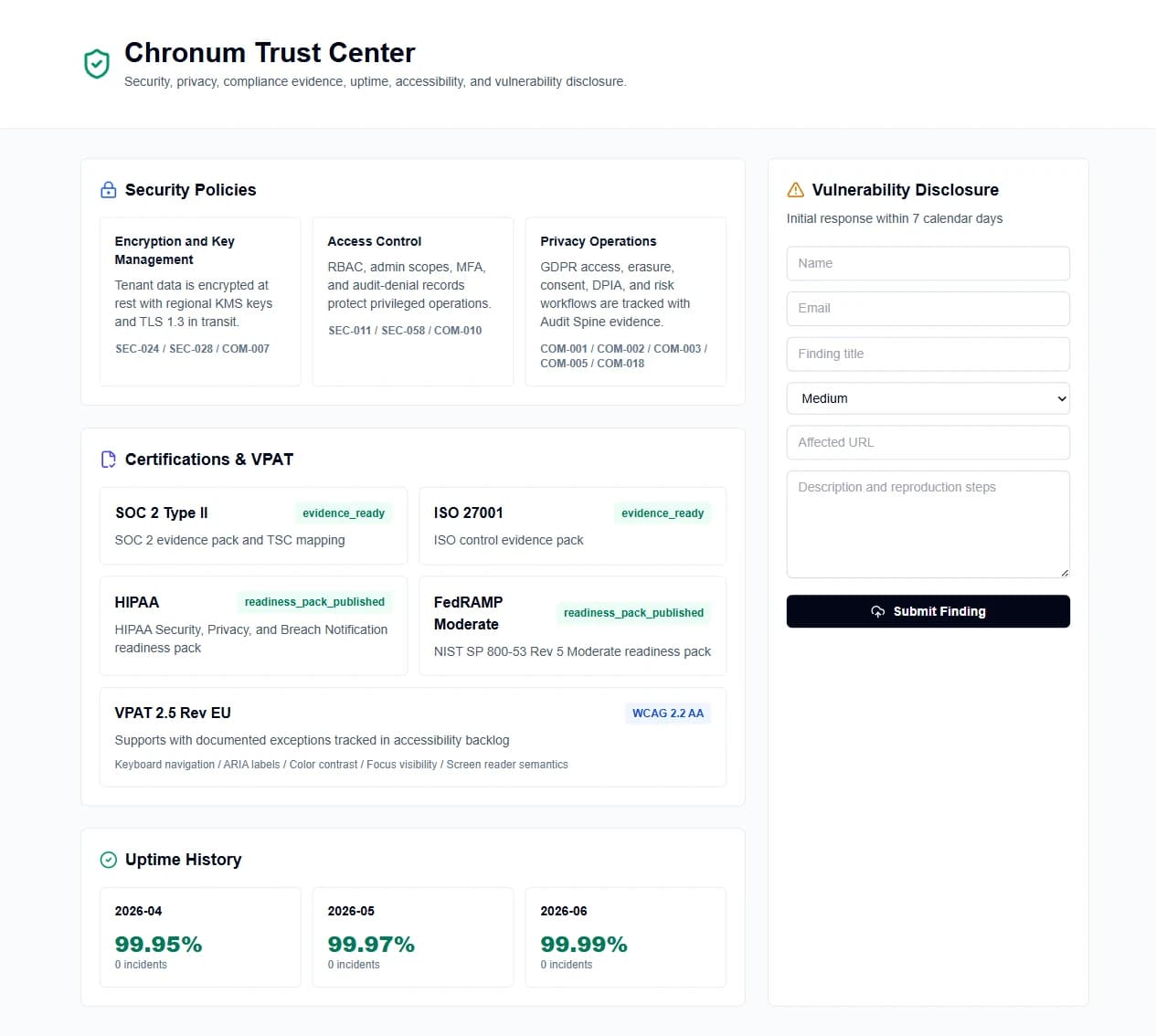
Chronum implements the control set these frameworks require and produces the evidence continuously. Certification is an audit your organisation runs — we supply the artefacts it needs.
Readiness packs are structured checklists of the technical and administrative controls each framework requires, mapped to the Chronum features that satisfy them and flagging any gaps — available from the Compliance & Trust Center.
Send us your security questionnaire
We would rather answer it up front than halfway through a procurement cycle. Architecture detail, data-flow diagrams and deployment options are all available for review.